
What Art School Admissions Actually Looks For
July 1, 2026
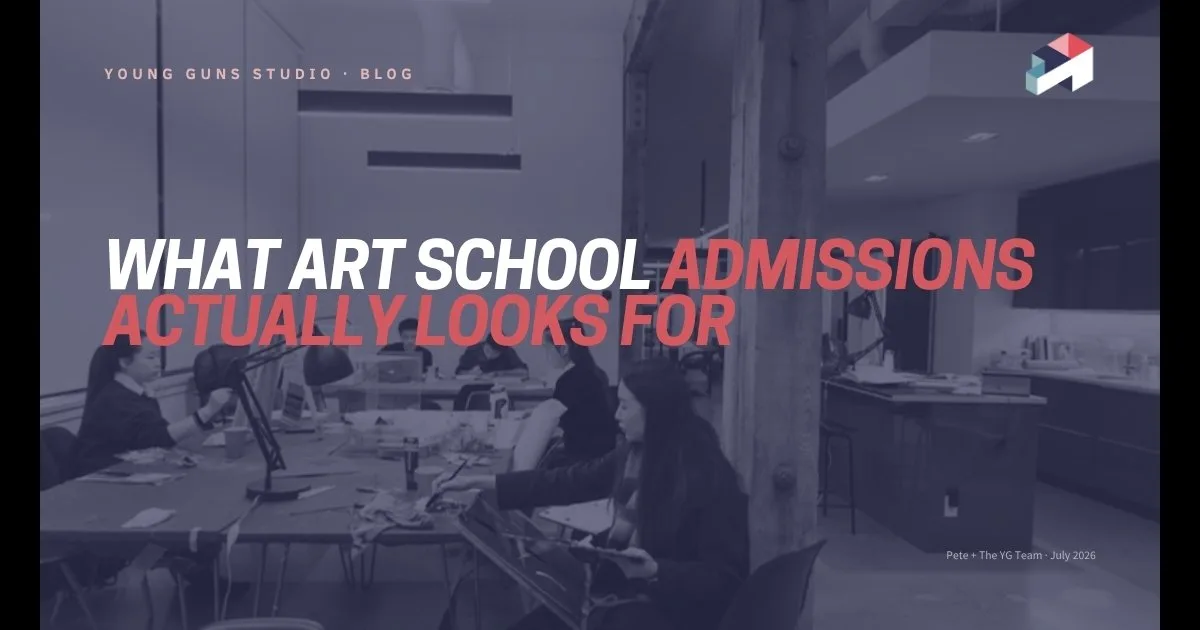
After guiding more than 900 students into programs at OCAD, Emily Carr, Parsons, RISD, and schools across Europe and Asia, one pattern becomes clear: the students who get in aren’t always the most technically advanced. They understand — or learn to understand — what admissions committees are actually evaluating. Here’s what we’ve learned.
1. They’re Not Just Looking at Skill — They’re Looking at Potential
Most rejected portfolios contain technically competent work. What separates accepted students isn’t perfection — it’s evidence of growth. Admissions reviewers want to see where you’re going, not just where you’ve been.
Show your development. Include work that demonstrates risk-taking, even if the result wasn’t perfect. A failed experiment that shows genuine curiosity will outperform a polished piece with nothing to say.
2. Your Portfolio Needs a Point of View
Twelve well-executed still lifes will not get you in. Schools want to understand how you see the world. Every piece should answer a question, explore a tension, or express a perspective — even if that perspective is still unresolved. A clear voice, even an uncertain one, is more compelling than polished emptiness. This could be a surreal self-portrait, a visual metaphor, or a narrative illustration, anything that reflects your ability to think conceptually and engage viewers on a deeper level.
3. Process Matters as Much as the Final Piece
Sketchbooks, drafts, and iteration pages are not optional. Admissions reviewers spend seconds looking at final pieces and minutes on process work. Your thinking is the portfolio. The final image is simply evidence that the thinking happened.
4. The Artist Statement Is the Make-or-Break
We’ve seen strong portfolios rejected because the statement was generic. “I love art and want to explore creativity” is a non-statement. Write about a specific moment that changed how you see. A specific question you can’t stop thinking about. Be specific. Be honest. Be a person, not a brand.
5. The Best Portfolios Have Range and Focus Simultaneously
This sounds like a contradiction — it isn’t. Range means you can work across media and styles. Focus means every piece still feels like it came from the same mind. The best portfolios have a recognizable sensibility, a consistent way of seeing, even when the work is formally diverse.
The students we’ve seen accepted to their first-choice schools aren’t always the most technically advanced in the room. They’re the ones who learned to trust their perspective and articulate it — in their work and on the page. That’s the thing we help you build.
Sketch you later,
Pete + The YG Team
